Middle school year 1 · seventh unit
The Solar System
The night sky changes a little every day and every month. Not because the stars move, but because the Earth we ride on turns, and the Moon goes round the Earth. Step outside the sky and look down from above.
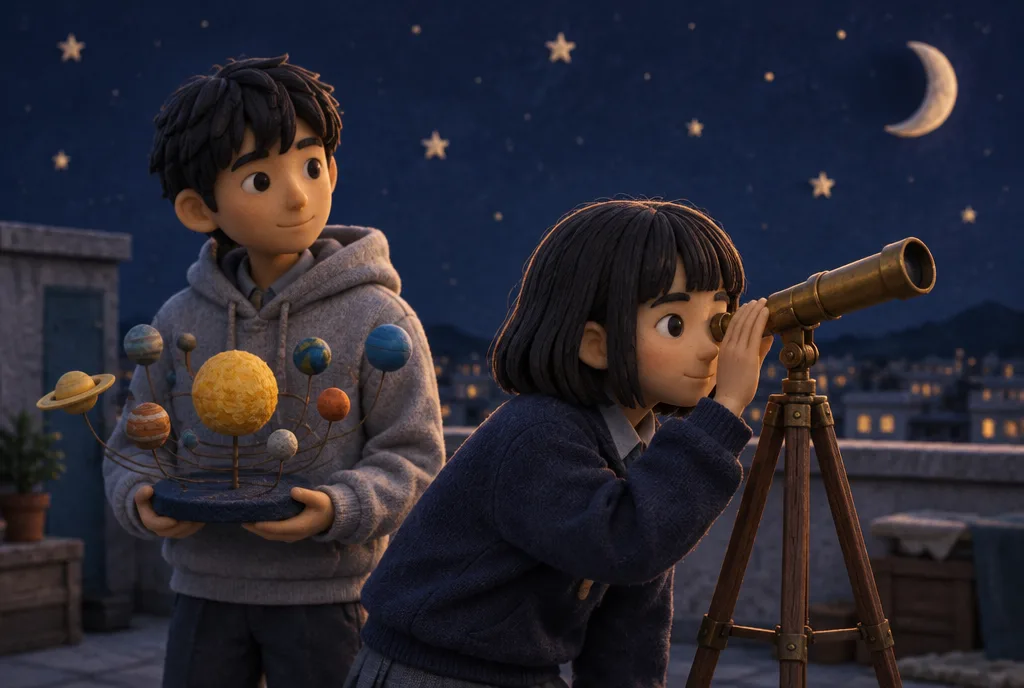
The eight planets fall into two groups
A board to arrangeWhat is alike and what is different? Pick up each planet, read its features, and drag them into the two boxes.
Scorpius of the summer night cannot be seen in winter
A board to adjustWhere has the constellation gone? Take hold of Earth and move it round the Sun.
The Moon changes shape over a month
A board to adjustIs the Moon really carved away and filled again? Take hold of it, move it round Earth, and see how it looks from Earth.
What to take away from this unit
- The planets of the solar system form two groups. The terrestrial planets (Mercury, Venus, Earth, Mars) are small and solid, with high density. The Jovian planets (Jupiter, Saturn, Uranus, Neptune) are big, with low density and rings.
- On the surface of the Sun there are sunspots, which look dark because they are cooler than their surroundings. When sunspots are many, the Sun is more active: auroras are seen more often on Earth and communications can be cut.
- Earth turns once a day on its own axis (rotation). That is why the Sun and stars seem to rise in the east and set in the west, 15° every hour.
- Earth goes round the Sun once a year (revolution). That is why the constellations seen at midnight change with the seasons.
- Only the sunlit half of the Moon is bright. As the Moon goes round Earth, how much of that bright side we see changes: these are its phases. They repeat about every 29.5 days.
- When the Moon covers the Sun it is a solar eclipse; when the Moon enters Earth's shadow it is a lunar eclipse.