Middle school year 2 · fourth unit
What Matter Is Made Of
Everything in the world is made of a hundred or so elements. The smallest particle of an element is an atom; atoms joined make a molecule; an atom with a charge is an ion. Assemble the unseen particles by hand.
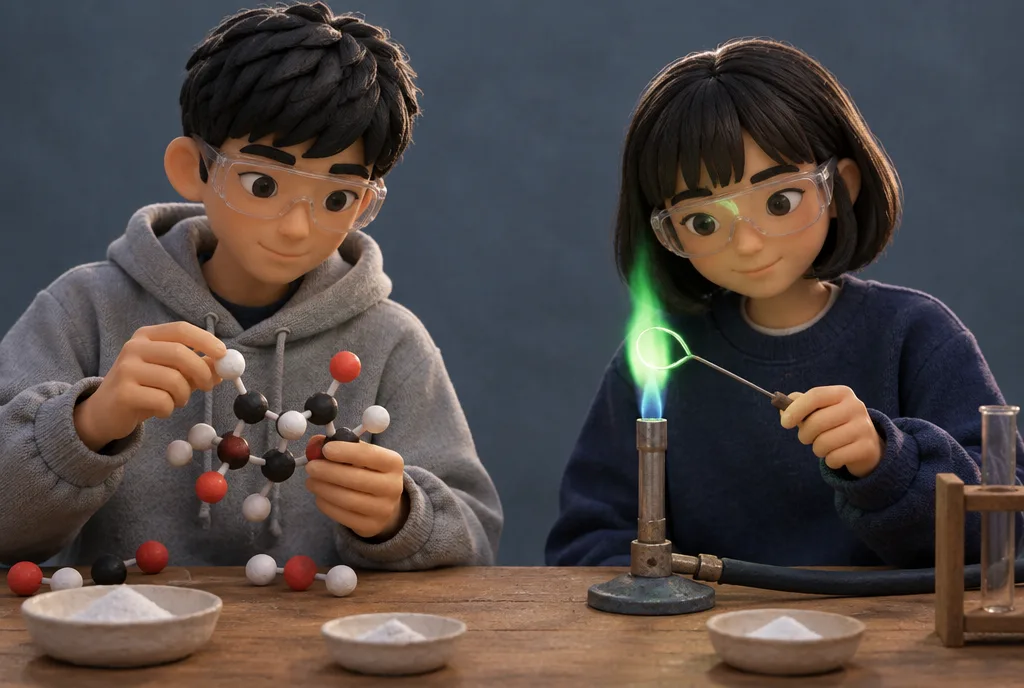
How do fireworks get their colours?
A board to arrangeThey all look like the same white powder. Drag a dish into the flame.
Is an atom a particle that cannot be split further?
A board to adjustInside an atom are a nucleus with (+) charge and electrons with (−) charge. Put electrons in and take them out.
Why is water written H₂O?
A board to arrangeDrag atom balls into the circle. How many of each does it take to make water?
Two clear liquids were mixed and turned cloudy
A board to arrangeThings dissolved and unseen in the water have met. Drag a bottle to a beaker.
What to take away from this unit
- An element is a basic ingredient of matter, written with a symbol: hydrogen H, oxygen O, carbon C. Some metal elements can be told apart by the colour of the flame test.
- An atom is the smallest particle of an element. At its centre is a nucleus with (+) charge, with electrons of (−) charge round it. The two charges are equal, so an atom has no overall charge.
- A molecule is atoms joined together: the smallest particle with the properties of the substance. A molecular formula gives the kinds and numbers of atoms. Water, H₂O, is 2 hydrogen atoms and 1 oxygen atom.
- An atom that loses electrons becomes a positive ion; one that gains them becomes a negative ion. The sodium ion is written Na⁺, the chloride ion Cl⁻.
- When certain positive and negative ions meet, an insoluble precipitate forms. Its colour tells which ions are in a solution.