Middle school year 1 · third unit
Heat
A spoon left in hot soup gets hot right up to the handle, and a room with the heater on warms to its corners. Move things by hand to see how heat travels, where it stops, and how it changes objects.
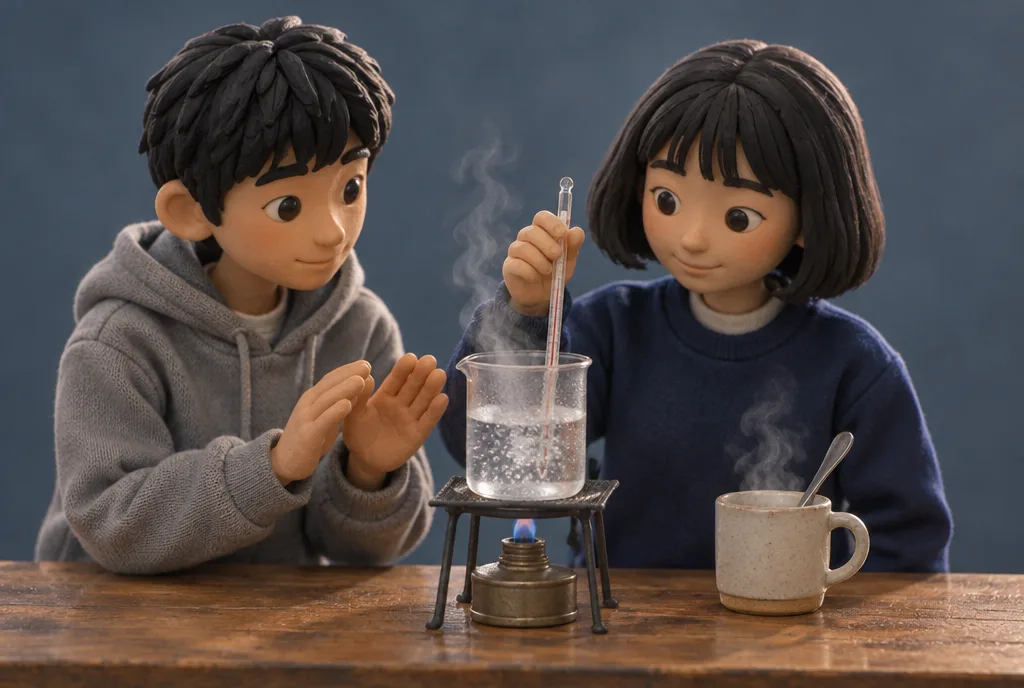
The spoon in the soup got hot right up to the handle
A board to runHow fast does heat travel along a rod? Put a rod on the support and drag the burner underneath it.
Heaters go on the floor, air conditioners near the ceiling
A board to arrangeWhat happens if they swap places? Drag the heater and the air conditioner up and down the room.
A heated iron ball went into cold water
A board to arrangeHow hot will the water get? Compare it with adding hot water at the same 100℃.
In midsummer the trains run slowly
A board to adjustThere is a gap between railway rails. Drag the sun up and down to change the temperature of the rails.
What to take away from this unit
- Temperature tells how vigorously the particles of a material are moving. Heat is energy that moves from where the temperature is high to where it is low.
- Heat travels in three ways: conduction, where shaking particles pass it to their neighbours; convection, where the warmed material itself moves round and carries it; and radiation, where it arrives directly with no material in between, like sunshine.
- When two objects at different temperatures touch, heat flows until their temperatures are equal. That state is called thermal equilibrium. It is also how a thermometer measures temperature.
- Specific heat is the heat needed to raise 1 kg of a material by 1℃. Water, with its large specific heat, warms slowly and cools slowly.
- When an object heats up, its particles move further apart and its length and volume increase. This is called thermal expansion. It is why gaps are left in railways and bridges.