Middle school year 1 · fourth unit
Changes of State
Ice, water and steam are the same substance. What differs is how the particles are gathered and how fast they move. Move the unseen particles by hand.
Nobody stirred, yet the ink spread through all the water
A board to arrangeSo who stirred it? Drag the dropper and put one drop of ink into the cold water and one into the hot.
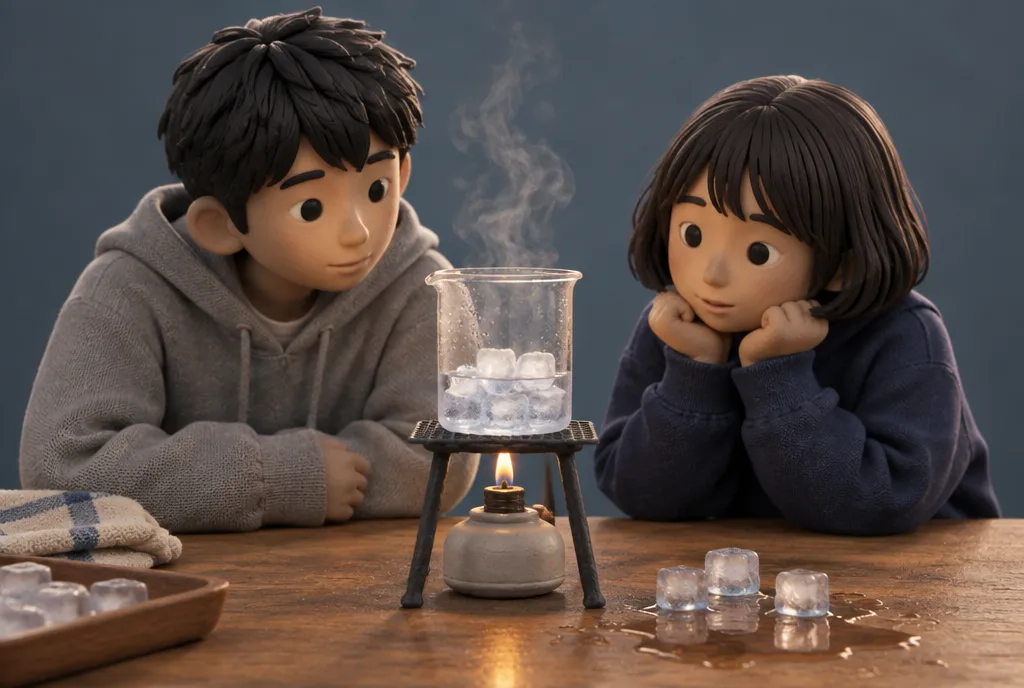
The ice is still being heated, but the thermometer has stopped
A board to runHeat is still going in. Where has it gone? Drag the burner under the beaker.
An icicle, the washing, frost: all changes of state
A board to joinWhat turned into what? Drag from the dot of a happening on the left to the dot of a name on the right.
What to take away from this unit
- The particles that make up matter never stop moving by themselves. That is why ink spreads (diffusion) and washing dries (evaporation). The higher the temperature, the faster they move.
- In a solid the particles shake in place, in a liquid they stay touching but change places, and in a gas they fly about far apart. When the state changes, the kind and number of particles stay the same, so the mass stays the same too.
- The changes of state have names. Between solid and liquid: melting and freezing. Between liquid and gas: vaporisation and condensation. Between solid and gas: sublimation.
- While the state is changing, the temperature stays the same. The temperature at which ice melts (the melting point) and at which water freezes (the freezing point) are the same, and the temperature at which it boils is the boiling point.
- Changes that move particles apart, like melting and vaporisation, take in heat; changes that bring them together, like freezing and condensation, give out heat. It is why drying sweat feels cool.