Middle school year 3 · seventh unit
Disasters and Safety
Earthquakes, typhoons and epidemics often cannot be stopped. But knowing why they happen and how they spread greatly reduces the harm. Use the science you have learned to protect yourself and your neighbours.
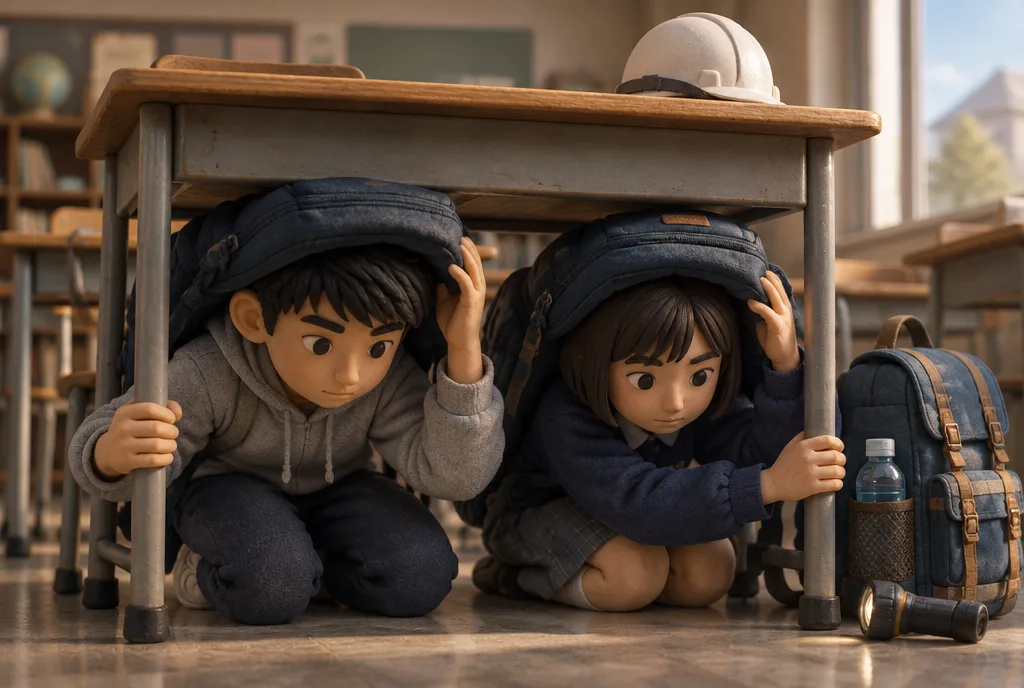
One magnitude 5.8 earthquake shook each town differently
A board to adjustThe magnitude on the news and the shaking you feel are different quantities. Drag the red star underground, and tap it to change the magnitude.
As a typhoon passes, its right side is the more dangerous
A board to adjustAt the same distance, why is the wind stronger on one side? Take the typhoon and drag it past our town.
One person’s cold spreads through the whole class
A board to runHow can it be made to spread less? Tap masks, hand washing and vaccination and compare the curves over 30 days.
Each disaster calls for a different response
A board to joinKnow what the danger is and the answer appears. Drag from the dot of a disaster on the left to the dot of an action on the right.
What to take away from this unit
- Harm caused by natural events is a natural hazard; together with accidents arising from human activity these are disasters. There are natural ones such as earthquakes, volcanoes and typhoons, and social ones such as epidemics, chemical spills and transport accidents.
- The magnitude of an earthquake is the size of the energy it releases; its intensity is how hard a given place is shaken. For the same earthquake, intensity is smaller farther from the focus.
- A typhoon’s wind is stronger to the right of its track (the dangerous half), because there the circling wind and the direction of travel agree.
- An infectious disease spreads as a pathogen passes between people. Hand washing and masks cut the chances to pass it on, and vaccination raises the number who cannot catch it, so it spreads less.
- Knowing how a disaster works tells you what the danger is and how to respond. The best preparation is to know in advance where to shelter and what to do.