Middle school year 1 · second unit
The Makeup and Diversity of Living Things
A frog, a pine and a mushroom are all made of very small rooms called cells. Move things by hand to see what is inside those rooms, how such varied living things are grouped, and why variety matters.
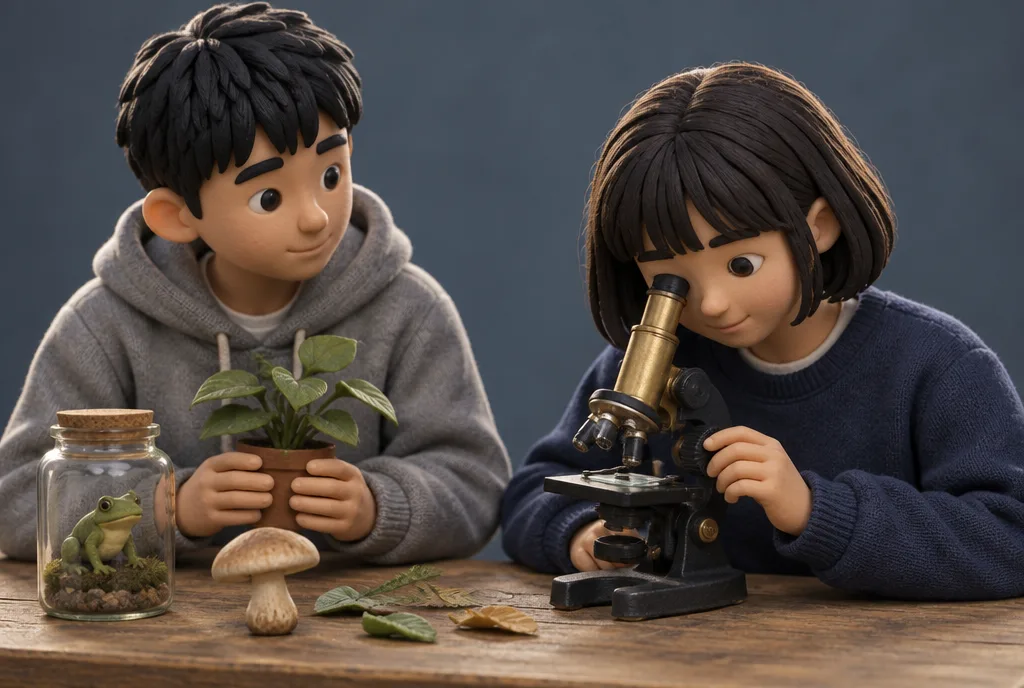
I looked at cheek cells and onion cells under a microscope
A board to arrangeThey looked different from the start. Is what is inside different too? Drag the parts in.
Is kelp a plant? What about a mushroom?
A board to arrangeLooks alone are confusing. Pick up each living thing, read its features, and sort them into five dishes.
The grasshoppers have gone from the meadow
A board to adjustDoes losing just one kind of creature matter? Tap a creature to remove it, then change the meadow and try again.
What to take away from this unit
- Every living thing is made of cells. Animal cells and plant cells both have a nucleus, a cell membrane and mitochondria; plant cells also have a cell wall and chloroplasts.
- Cells make up tissues, tissues make up organs, and organs make up one living thing (an organism). These are called the levels of organisation.
- Living things are grouped by their features, not their looks (classification). By whether there is a nucleus, whether there is one cell or many, and how food is obtained, they are divided into five kingdoms.
- Even living things of the same kind differ a little in form. This is called variation. As those that suit their surroundings survive in greater numbers, life becomes more varied. You can run it yourself on the natural selection board.
- The more varied the living things, the better an ecosystem survives the loss of one. That is why biodiversity has to be protected.